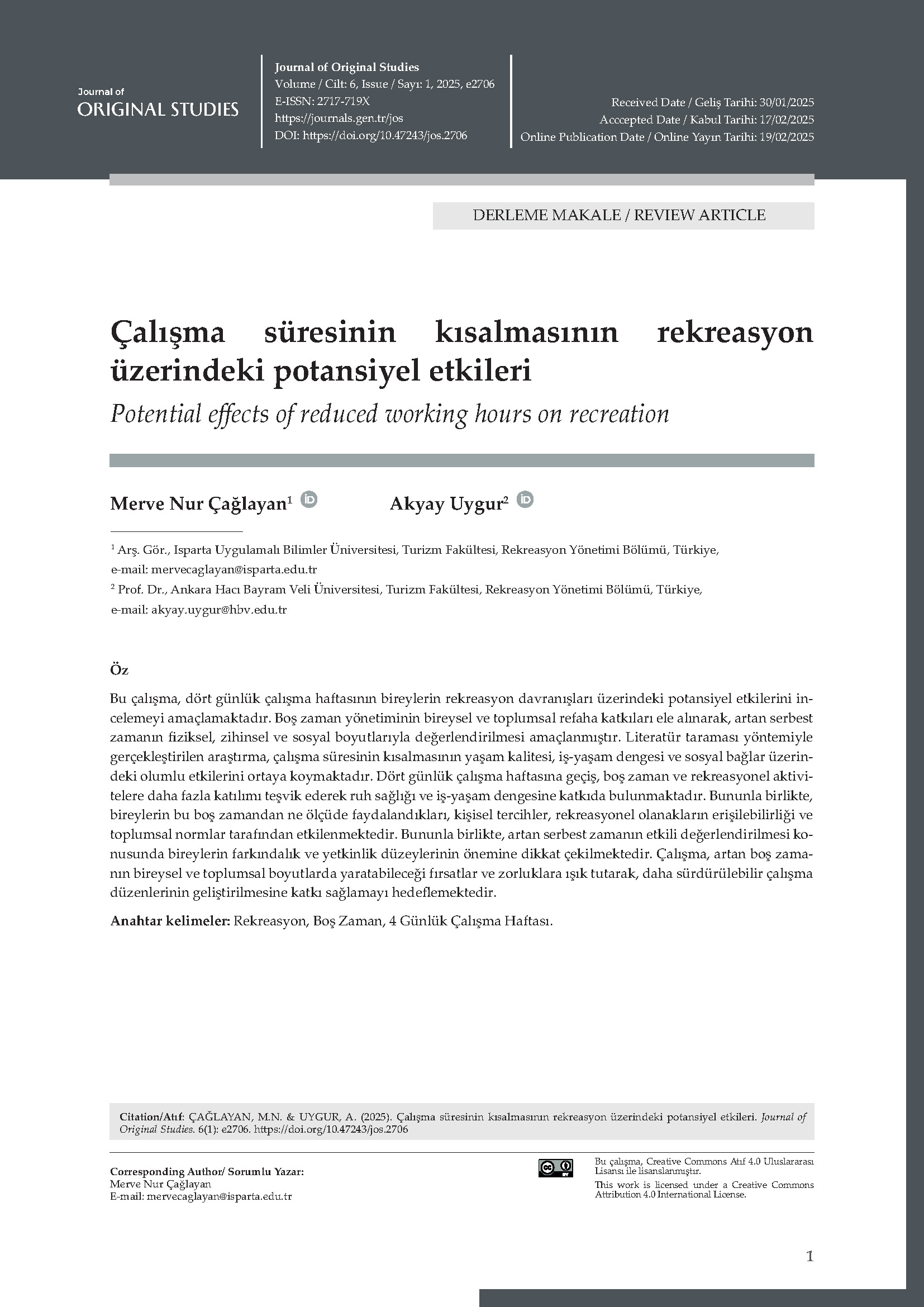
Potential effects of reduced working hours on recreation
 Abstract views: 79
/
Abstract views: 79
/  PDF downloads: 71
DOI:
https://doi.org/10.47243/jos.2706Keywords:
Recreation, Leisure Time, 4 day work weekAbstract
This study aims to examine the potential effects of a four-day workweek on individuals' recreational behaviors. By addressing the contributions of leisure management to individual and societal well-being, the study evaluates the increased availability of free time in its physical, mental, and social dimensions. Conducted through a literature review, the research highlights the positive impacts of reduced working hours on quality of life, work-life balance, and social connections. The transition to a four-day workweek promotes greater participation in leisure and recreational activities, contributing to mental health and work-life balance. However, the extent to which individuals benefit from this increased free time is influenced by personal preferences, the accessibility of recreational opportunities, and societal norms. Additionally, the study emphasizes the importance of individuals' awareness and competencies in effectively utilizing this additional free time. By shedding light on the opportunities and challenges that increased leisure time may create on both individual and societal levels, this study seeks to contribute to the development of more sustainable working arrangements.
Downloads
References
DAY WEEK GLOBAL, (t.y.). 4 Day Week Trial Results, https://www.4dayweek.com/research. [Erişim Tarihi: 04.01.2025].
ALFARES, H. K. (2003). Flexible 4-day workweek scheduling with weekend work frequency constraints. Computers & Industrial Engineering, 44(3), 325-338.
AUTOR, D. H. (2019, May). Work of the Past, Work of the Future. In AEA Papers and Proceedings (Vol. 109, pp. 1-32). 2014 Broadway, Suite 305, Nashville, TN 37203: American Economic Association.
BALLA, A. (2024). The four-day work week-an inevitable revolution or a passing fad?. Zeszyty Naukowe Politechniki Śląskiej. Organizacja i Zarządzanie, (207), 9-23.
BIRD, R. C. (2010) The four-day work week: old lessons, new questions. Connecticut Law Review 42(4), 1059–1080.
BODUR, M. Y. (2019). Yoğunlaştırılmış iş haftası, denkleştirme süresi ve bundan doğan hukuki sorunlar. Süleyman Demirel Üniversitesi Hukuk Fakültesi Dergisi, 9(1), 285-352.
BOSTON COLLEGE. (t.y.). A four-day work week? https://www.bc.edu/bc-web/bcnews/nation-world-society/sociology/-study-pilots-four-day-work-week.html. [Erişim Tarihi: 05.01.2025].
BÜLBÜL, A., OLCUCU, B., & AKYOL, G. (2021). Spor elemanlarının rekreasyon fayda farkındalığı ile bedenlerini beğenme düzeyleri arasındaki ilişki. Karadeniz Uluslararası Bilimsel Dergi, 1(50), 110-123.
CHUNG, H. (2022). A social policy case for a four-day week. Journal of Social Policy, 51(3), 551-566.
CHUNG, H., & VAN DER HORST, M. (2018). Women’s employment patterns after childbirth and the perceived access to and use of flexitime and teleworking. Human Relations, 71(1), 47-72.
CNN TÜRK, (2023). Haftada 4 gün mesai kalıcı hale geldi. https://www.cnnturk.com/ekonomi/turkiye/haftada-4-gun-mesai-kalici-hale-geldi-1907144. [Erişim Tarihi: 05.01.2025].
CRUZ, S. A., COUTO, A. I., OLIVEIRA, A., CERDEIRA, J., PARENTE, C., & GONÇALVES, C. M. (2024). Work time reduction: the 4-day work week . Conferência - Investigação E Intervenção Em Recursos Humanos, (12).
ÇETINER, H., 2019. Sağlık rekreasyonu kapsamında terapatik rekreasyon uygulamaları. Journal of Recreation and Tourism Research, 6(4), 405-411.
ERGUVEN, A. T., EKINCI, N. E., & CAN, K. M. (2023). Daha fazla serbest zaman daha az iş: 4 gün çalışma programı. Journal of ROL Sport Sciences, 1098-1123.
EURO NEWS, (2024). Four-day week: Which countries are embracing it and how is it going so far? https://www.euronews.com/next/2024/02/02/the-four-day-week-which-countries-have-embraced-it-and-how-s-it-going-so-far#:~:text=Belgium%20became%20the%20first%20country,five%20without%20loss%20of%20salary. [Erişim Tarihi: 06.01.2025].
GALBI, D. (1997). Child labor and the division of labor in the early english cotton mills. Journal of Population Economics, 10(4), 357–375.
GRAHAM-MCLAY, C. (2018, July 19). A 4-day workweek? A test run shows a surprising result. The New York Times.https://www.nytimes.com/2018/07/19/world/asia/four-day-workweek-new-zealand.html. [Erişim Tarihi: 06.01.2025].
GÜRSOY, Ö., & SEVIN, H. D. (2021). Boş zaman aktivitelerine katılım ile algılanan wellness (esenlik) ilişkisi. OPUS International Journal of Society Researches, 18(42), 5444-5479.
HARALDSSON, G., & KELLAM, J. (2021). Going public: Iceland’s journey to shorter working hours. Alda – Association for Democracy and Sustainability. https://autonomy.work/wp-content/uploads/2021/06/ICELAND_4DW.pdf. [Erişim Tarihi: 06.01.2025].
HUNNICUTT, B. K. (1988). Work without end: Abandoning shorter hours for the right to work. Temple University Press.
ILO. (1919). Hours of Work (Industry) Convention, 1919 (No. 1). https://www.ilo.org/dyn/normlex/en/f?p=NORMLEXPUB:12100:0::NO::P12100_ILO_CODE:C001. [Erişim Tarihi: 06.01.2025].
ILO. (2000). Reduction of Working Time Recommendation, 1962 (No. 116). https://www.ilo.org/dyn/normlex/en/f?p=NORMLEXPUB:12100:0::NO::P12100_ILO_CODE:R116. [Erişim Tarihi: 06.01.2025].
ILO. (2018). The Employment Impact of Technological Change. https://www.ilo.org/global/topics/future-of-work/publications/WCMS_624711/lang--en/index.htm. [Erişim Tarihi: 06.01.2025].
IŞIKGÖZ, M. E., GÜRBÜZ, P. G., & ESENTAŞ, M. (2021). Üniversite öğrencilerinin boş zaman yönetimlerinin çeşitli değişkenler açısından incelenmesi. Uluslararası Güncel Eğitim Araştırmaları Dergisi, 7(1), 413-429.
JAHAL, T., BARDOEL, E. A., & HOPKINS, J. (2024). Could the 4‐day week work? A scoping review. Asia Pacific Journal of Human Resources, 62(1), e12395.
KAYGUSUZ, Ö., & GÜMÜŞ, H. (2021). Çalışan kadınlarda boş zaman yönetimi ve sağlıklı yaşam biçimi davranışlarının incelenmesi. Türkiye Spor Bilimleri Dergisi, 5(1), 45-53.
KELLIHER, C., & ANDERSON, D. (2008). For better or for worse? An analysis of how flexible working practices influence employees' perceptions of job quality. The International Journal of Human Resource Management,, 19(3), 419-431.
KELLY, O., SCHOR, J., FAN, W., BEZDENEZHNYKH, T., GU, G., & BRIDSON HUBBARD, N. (2022). The Four Day Week: Assessing global trials of reduced work time with no reduction in pay: Evidence from Ireland. University College Dublin.
LAMBERT, A. D., MARLER, J. H., & GUEUTAL, H. G. (2008). Individual differences: Factors affecting employee utilization of flexible work arrangements. Journal of Vocational Behavior, 73(1), 107-117.
MILLIYET, (2024). Çalışanlar dikkat: İlk kez bir Türk şirket denedi! İşte haftada 4 gün mesainin çalışana etkisi. https://www.milliyet.com.tr/ekonomi/calisanlar-dikkat-ilk-kez-bir-turk-sirket-denedi-iste-haftada-4-gun-mesainin-calisana-etkisi-7113353 [Erişim Tarihi: 05.01.2024].
NARDINELLI, C. (1980). Child Labor and the Factory Acts. Journal of Economic History, 40(4), 739–755.
OPEN ACCESS GOVERNMENT. (2023). Why a 4-day week works for some companies but not others. https://www.openaccessgovernment.org/why-4-day-week-works-companies-success/155566/. [Erişim Tarihi: 06.01.2024].
ÖZTAŞ, Ş., & KIYLIOĞLU, L. (2021). Kapitalizmle ilişkisi bağlamında boş zaman ve gençlik. Kültür Araştırmaları Dergisi, (9), 338-358.
PENCAVEL, J. (2015). The Productivity of Working Hours. Economic Journal, 125(589), 2052–2076.
RODGERS, G., LEE, E. SWEPSTON, L. & VAN DAELE, J. (2009). The International Labour Organization and the quest for social justice, 1919-2009. International Labour Office: Geneva. https://www.ilo.org/publications/international-labour-organization-and-quest-social-justice-1919-2009 . [Erişim Tarihi: 06.01.2024].
SCHMITZ, V. (2023). Vier-Tage-Woche im Überblick: Wo gibt es sie und was sagen Studien? https://www.augsburger-allgemeine.de/geld-leben/arbeitszeitmodell-4-tage-woche-studien-und-laendervergleich-id65305176.html. [Erişim Tarihi: 06.01.2024].
SNG, M., KHOR, W., OIDE, T., SUCHAR, S. C., & TAN, B. C. (2021). Effectiveness of a Four-days/Eight Hour Work Week. https://commons.erau.edu/ww-research-methods-rsch202/21. [Erişim Tarihi: 07.01.2024].
TOZLU, E. (2011). Genel olarak esnek çalışma sistemleri ve tele çalışma ve sıkıştırılmış iş haftasının karşılaştırılması. Süleyman Demirel Üniversitesi Vizyoner Dergisi, 3(4), 99-116.
WALDEN UNIVERSITY. (t.y.). Shortened work weeks: What studies show. https://www.waldenu.edu/programs/business/resource/shortened-work-weeks-what-studies-show. [Erişim Tarihi: 07.01.2024].
WELT. (2023, July 15). Das passiert wirklich, wenn Firmen die Vier-Tage-Woche einführen. https://www.welt.de/252933408. [Erişim Tarihi: 07.01.2024].
WORLD ECONOMIC FORUM. (2023, October 25). Four-day work week trial in Spain leads to healthier workers, less pollution. https://www.weforum.org/stories/2023/10/surprising-benefits-four-day-week/. [Erişim Tarihi: 07.01.2024].
YAKKAN, E. (2016). Çalışma hayatında esnekleşme ve esnek çalışma biçimleri. Yüksek Lisans Tezi, Dokuz Eylül Üniversitesi, Sosyal Bilimler Enstitüsü, Çalışma Ekonomisi ve Endüstri İlişkileri Anabilim Dalı, İzmir.
YARNO. (2021). How our 4-day work week turned into a 2 year failed experiment. https://www.yarno.com.au/blog/4-day-work-week-failure/. [Erişim Tarihi: 07.01.2024].
YILDIRIM, F. (2023). Esnek çalışmanın kadın istihdamına etkileri. Yüksek Lisans Tezi. Karadeniz Teknik Üniversitesi, Sosyal Bilimler Enstitüsü, Çalışma Ekonomisi ve Endüstri İlişkileri Anabilim Dalı, Trabzon.
Downloads
Published
How to Cite
Issue
Section
License
Copyright (c) 2025 Holistence Publications

This work is licensed under a Creative Commons Attribution 4.0 International License.
When the article is accepted for publication in the Journal of Orijinal Studies, authors transfer all copyright in the article to the Holistence Academy Ar-Ge Yazılım Yayıncılık Eğitim Danışmanlık ve Organizasyon Ticaret Ltd. Şti.The authors reserve all proprietary right other than copyright, such as patent rights.
Everyone who is listed as an author in this article should have made a substantial, direct, intellectual contribution to the work and should take public responsibility for it.
This paper contains works that have not previously published or not under consideration for publication in other journals.